
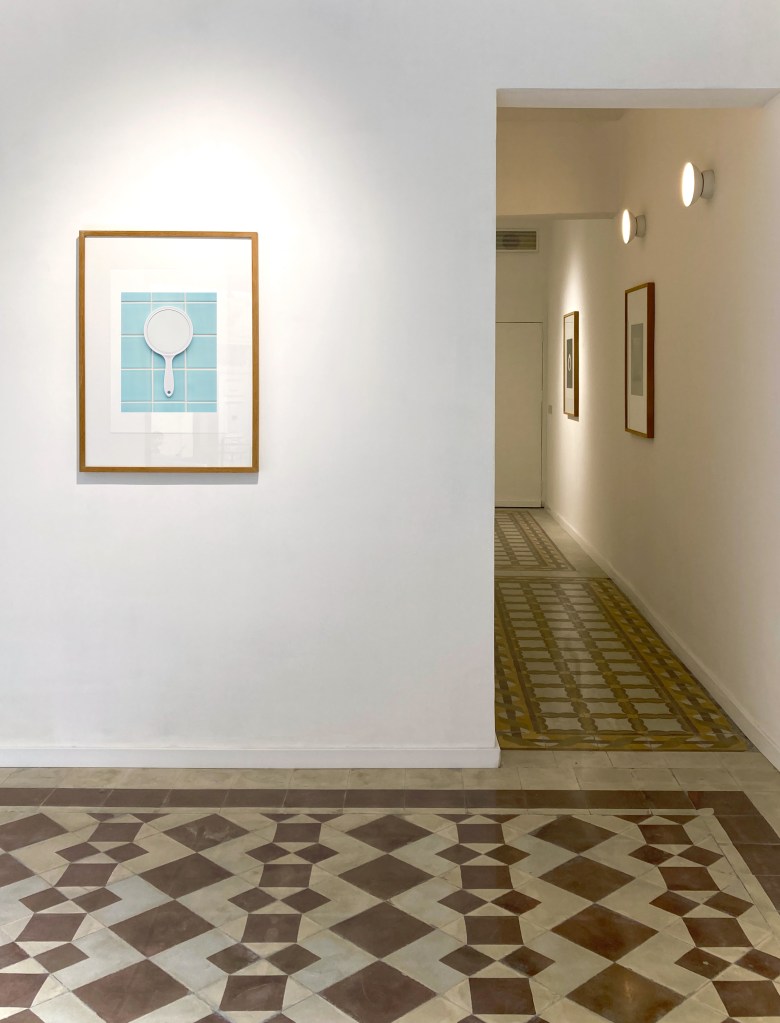
The Autumn months at Jo Borg Gallery have introduced the local public and art aficionados to the photographic oeuvre of Claus Goedicke, born in Cologne in 1966, and best known as the photographer of things. Since his early years studying under Bernd Becher at the Kunstakademie in Düsseldorf (1989 – 1995), from where he graduated as a Meisterschüler, objects have played a central role in his artistic vision.
In this first part of his artistic career, packaging, containers, boxes and food enabled the artist to explore the representational capacity of photography in relation to the ordinary. His work is concerned with questions like: What should be photographed, and why? What objects allow themselves to be photographed and in what conditions? These inquiries form the basis of Goedicke’s practice, which challenges the conventional role of photography as mere documentation and representation. Instead, he treats photographs as autonomous objects, independent of subjective interpretation or universally accepted truths, as his practice revolves around fundamental questions surrounding photography and its autonomy.
Building on these inquiries, the pictures presented in the series Dinge (2007-2017) delve into the connection between humans and the things that feature in their daily lives.
By focusing on the mundane; familiar but elementary objects that potentially play a role in nearly everybody’s biography, Goedicke highlights how these things reveal not only current physical needs but also intellectual and emotional constructs. It is in these simple everyday objects, like a book, a glass of water, a doll, a flute, dice, a pair of compasses, pills, or a shroud, that the artist seeks and finds evidence of how humans shape and mould their world.
In so doing, the photographs inevitably reveal the deeper aspects of design, utility and cultural significance inherent in each object, as they grasp the complex relationship between transience and permanence.
An overarching principle in Goedicke’s canon of things is that they are small enough to be held in the palm of one’s hand, emphasising the intimate relationship between vision and touch. Adding to this aesthetic experience are the meditative spaces created by Goedicke’s minimalist compositions, inviting the viewer to reflect on the role these objects could play in their lives. Placed in isolation, Goedicke elevates the status of these objects from their seemingly ordinary context into a contemplative one. An approach that imbues his photos with a rich narrative, by which the artist explores the intersection of human intent and material existence. Goedicke holds that the act of handling and using objects is as important as seeing them, a sensory connection that merges the stillness of visual contemplation and the tactile interaction with things.
Goedicke’s work pays tribute to visual traditions of painting and photography. He draws inspiration from the still lifes of artists like Chardin, Cézanne, Matisse, and Morandi, as well as from movements like New Objectivity and conceptual art. Such influences are evident in his technical precision and objectivity. Alongside such traits, Goedicke’s work is informed by the slick visual language of advertising, where objects are often idealised and stripped of their practical functions. This merging of influences allows Goedicke to create images that are both intellectually rigorous, visually striking, and relevant to contemporary times.
Over the years, this disciplined approach has cemented Goedicke as a key figure in contemporary German photography. A retrospective of his work was exhibited at the Josef Albers Museum Quadrat in Bottrop, Germany in 2017 and his photographs were included in various collective shows in Germany and worldwide. His work forms part of several private and public collections, including the Josef Albers Museum Quadrat Bottrop, the Museum Folkwang, the Museum of Fine Arts, Houston, and the Centre Pompidou, among others. Goedicke’s skill to imbue objects with profound meaning and conceptual depth has attracted the attention of highly regarded institutions that value his ability to blend timeless artistic tradition with modern concerns about consumerism and materiality. The artist’s ongoing preoccupation with the human-object relationship sheds a new light on the mundane, making Goedicke a significant voice in the broader conversation about photography’s role in contemporary art.
Press:
Photographs by Claus Goedicke go on display at Jo Borg Gallery
 Jo Borg Gallery